

Our Autumnal trip to Firenze would not have been the same without taking in its magnificent musei, gallerie, palazzi, and giardini. Each reveals a different facet of the city’s cultural legacy. We visited as many museums as time allowed, discovering not only celebrated landmarks, but also the details that make Florence so evocative.
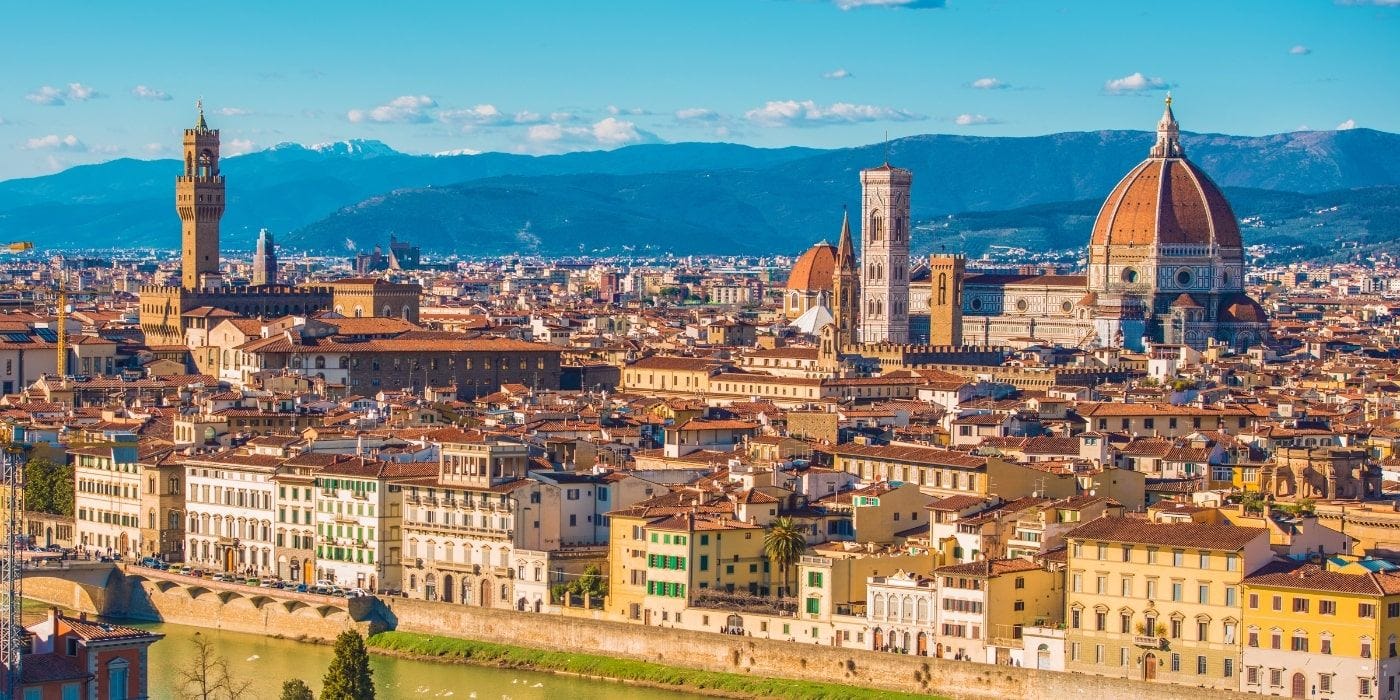
This Tuscan capital is exceptional for the concentration of history interlinked into its everyday streets. Its historic center was inscribed on the UNESCO World Heritage List in 1982, recognizing its exceptional contribution to art, urban fabric, and the development of the era.
The distinction carries a responsibility. Italian cultural heritage legislation, together with local planning and conservation policies, protects much of the historic center. Restoration and alterations to protected structures are subject to official oversight, helping preserve their materials, technical mastery, façades, and past character. UNESCO status does not prohibit every form of new construction, but it reinforces importance of safeguarding the jewel’s inheritance.
What makes Florence so captivating is that it’s past is not confined to galleries. It remains visible in the streets, courtyards, palaces, bridges, and other blueprints that continue to shape daily life. Generations of ambition, imagination and skills are still written into the historic stronghold.
Amongst the details that held my attention most were the steps, which are an absolute goldmine here. Looking at the city through that structural lens turned our trip into a completely unique treasure hunt, a journey of literal and artistic ascension.


I have always been drawn to their mystery, where they begin, where they lead, what they conceal and reveal. There is something persuasive about the anticipation of reaching the next landing and discovering what lies beyond it.
I admire the precision of their engineering the balance of their proportions, and the ingenuity of their forms. Marble, wood, iron, steel, glass, crystal, onyx, gold, and silver each bring a different perspective to a grand stairway. Some sweep upward with theatrical grandeur, others turn gracefully within confined spaces or emerge from courtyards and gardens. Their purpose maybe practical and spatial, but their effect is often far more significant. They frame a view, define a room, direct the eye, and create a sense of arrival.
Stairwells became a way of reading the metropolis, a fascination of power, ambition, virtuosity, and the people who shaped its earlier generations. Connecting one period to another, one room to another, and sometimes one world to an entirely different one.
The weather was crisp and clear, with generous Tuscan sunshine. And plenty of reasons to keep looking up.
Gallerie delgi Uffizi


One of the world’s great collections of Renaissance art. Commissioned by Cosimo I de’ Medici in 1560, the Uffizi Gallery blueprints were designed by Giorgio Vasari, to house the administrative and judicial offices. The name Uffizi derives from the Italian word for offices. Vasari’s visual language is striking in its discipline. Two long wings frame a narrow courtyard that opens toward the Arno. Conceived for the businesses for government, yet it would eventually become one of the most celebrated repositories of creative works in the world.
Even the entrance sequence tells a story. The climb through the Uffizi brings together two periods of composition. The earlier staircase, associated with Vasari, reflects the restrained elegance of Florentine flowering, with Pietra serena stone against pale plaster. The later section, designed by Zanobi del Rosso in the early 1790s, introduces a different sensibility, with an elliptical vestibule and distinctive Lorraine-green tones. The change in style is a reminder that a building, like a city, is shaped by successive generations.
The flight of steps lead visitors upward towards the galleries and the amazing treasures assembled through Medici patronage. The climb becomes a transition, from the movement of the city outside to the rooms filled with works that transformed European fine arts. It is a fitting entrance to a place where power, patrimony, and artistic vision have been intertwined for centuries.
Palazzo Vecchio
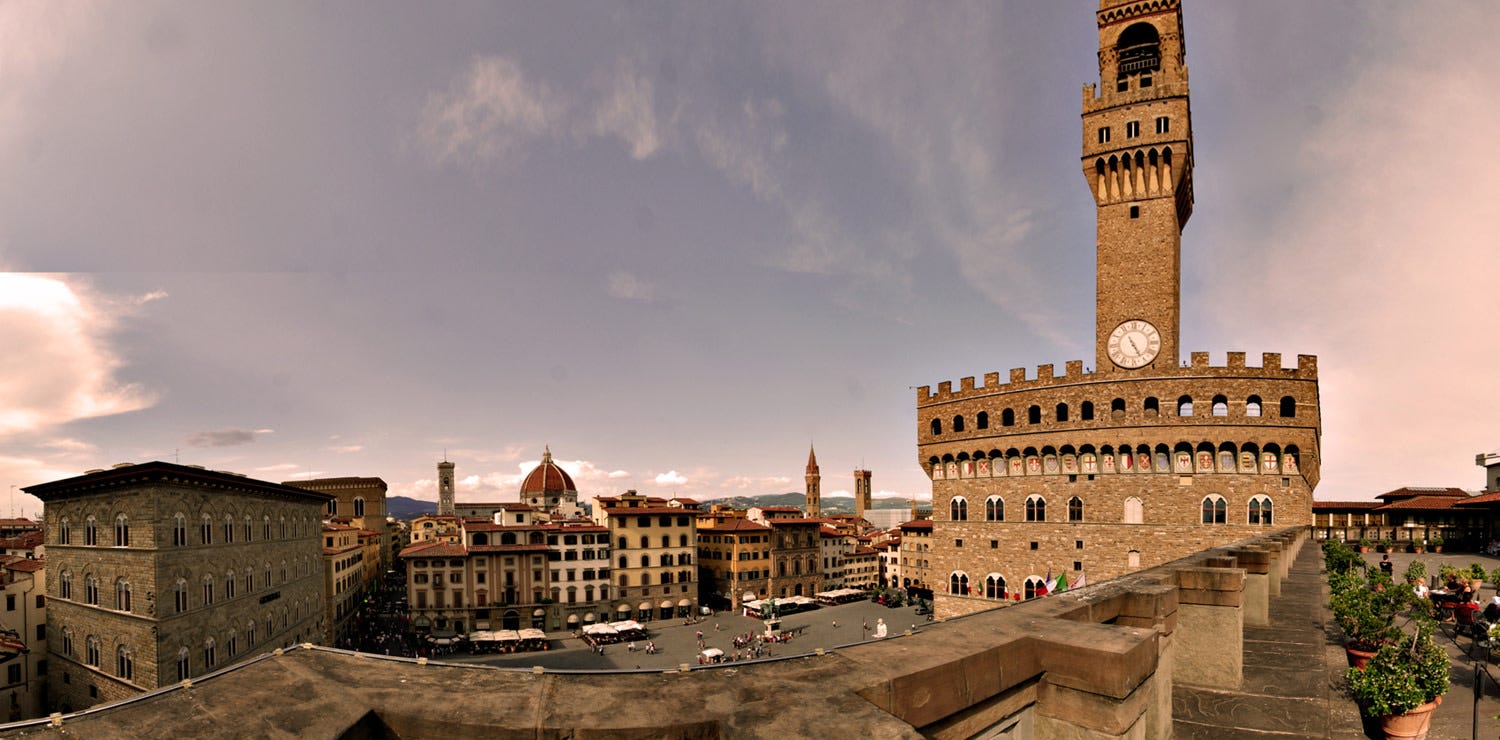
Next on the agenda, meticulously curated for us by Eric, our curator at our Florentine Residence, This Time Tomorrow.
Palazzo Vecchio, the historic seat of Florence’s civic government. Assembly, fabrication and engineering began in 1299. Its imposing stone façade and tall tower dominate Piazza della Signoria. We viewed the palace from the outside after our museum visit. Its commanding proportions convey authority and civic pride without the need for ornament.
Cathedral of Santa Maria del Fiore
Fiore, better known as the Duomo, was another commanding silhouette. The white, green, and pink marble exterior is intricately patterned, with details that reward a closer look. Execution began in 1296, and Filippo Brunelleschi’s breathtaking dome was completed in 1436. Its scale and engineering remain astonishing, particularly when viewed from the streets surrounding the cathedral.


Florence has an unusual ability to place monumental achievements within the flow of ordinary life. A palace, a cathedral, a public square, each both a landmark and part of the city’s living fabric.
Bargello, Intricacies of Florence
The Museo Nazionale del Bargello offered a different perspective on Florence. Housed inside a medieval foundation originally commissionedas the Palazzo de Podestà, it later served as a prison and policeheadquarters before becoming a national museum in 1865. Today, it is renowned for its archive of middle ages and classical revival sculpture.
The landmark itself is worth exploring closely. The highlight of the structure is the massive, imposing courtyard staircase. Climbing those open-air stone steps, my hand tracing the worn balustrade, where stones seemed to whisper old secrets. The energy quickly shifts in the sublime grace of Donatello’s bronze David, the shockingly sleek, subversive masterpiece waiting just inside. The staircase rises from the courtyard along the palace wall, drawing the eye toward the upper loggias.
Inside, works by Donatello and other masters reveal the harmonioustechnical and creative breakthroughs that defined the era. This rich assemblage of sculpture gains another dimension from the setting itself. An edifice that has witnessed centuries of Florentine heritage.
Arno and Ponte Vecchio
Crossing the bridge toward the Arno and Ponte Vecchio in the sunshine was one of the pleasures of our visit. Its pastel-colored edifices, jewelry shops, and distinctive profile make it instantly recognizable. The present bridge dates to 1345, and its shops continue a commercial tradition that has become inseparable from its identity.


We paused in the center, where the views open along the river. Musicians played nearby, rowers moved across the water, and the establishments seemed to glow in the afternoon light. It was a moment to take photographs, but also to simply stand and watch the life of the town unfold.
Above the bridge runs the Vasari Corridor, an elevated passage commissioned by Cosimo I de’ Medici in 1565, connecting the Medici’s government headquarters at Palazzo Vecchio with their residence at Palazzo Pitti, allowing the ruling family to move between the two without passing through the busy streets. A private passage for the ruling family, an architectural solution offering both convenience and separation from the public life below.
The corridor passes above Ponte Vecchio, linking two important centers of power. Its narrow route and elevated position reveal more than architectural ingenuity. They speak of privilege, security, and the desire to remain apart from public life. It is fascinating to imagine the Medicitravelling above the bridge while merchants, residents, and visitors moved below.
During our lovely lunch break, we were chatting with an Italian gentleman who offered words of wisdom.
“To see Florence, you must look up. The tourists look at the shops windows, the history is in the cornices, and the clouds.”
It was a simple observation, but a perceptive one. The upper façades, cornices, rooflines, and details above street level often reveal as much about an urban center as its celebrated monuments.
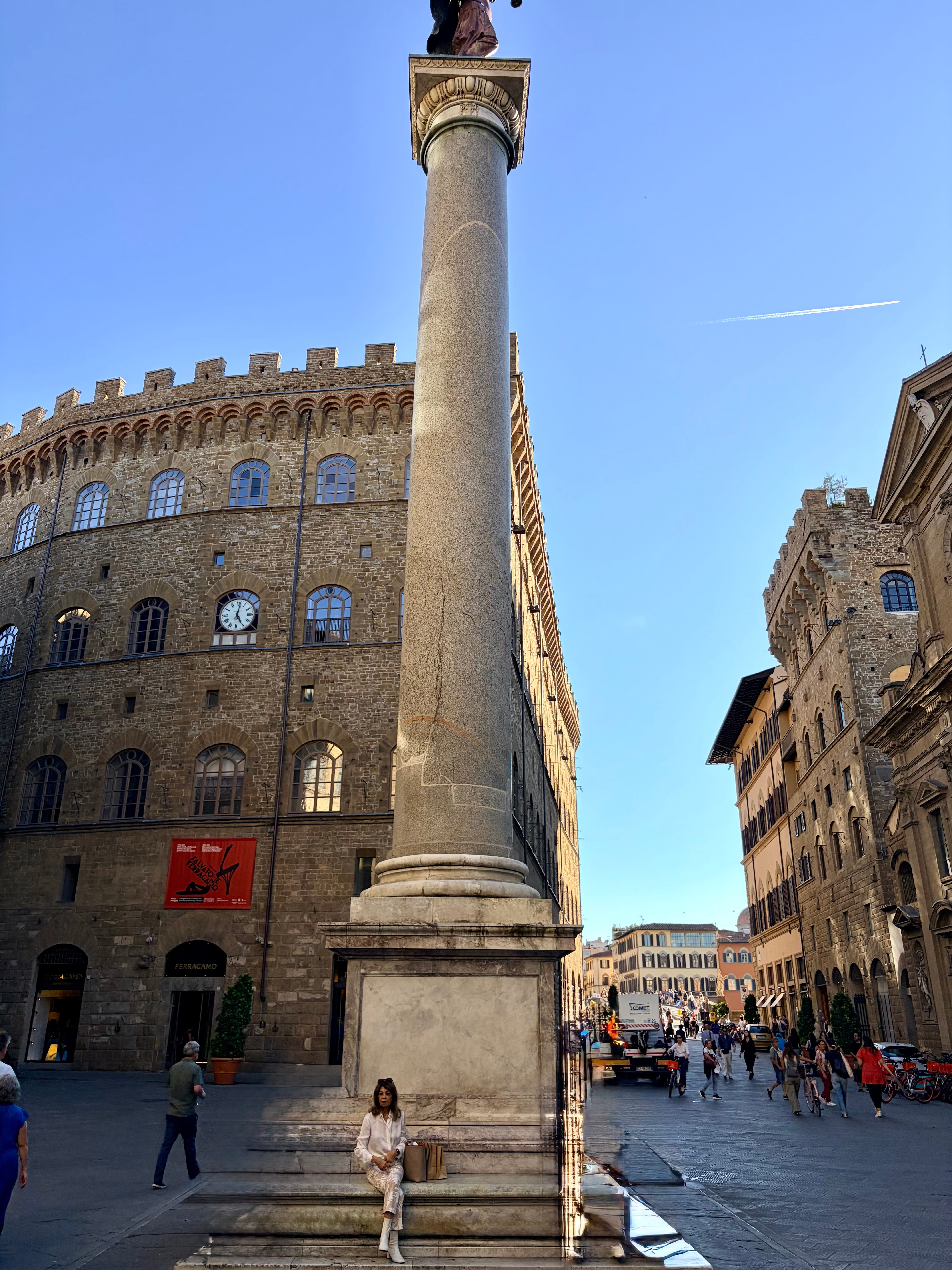
We stopped at the Column of Justice in Piazza Santa Trinita. The ancient column originated at the Baths of Caracalla in Rome and was presented to Medici by Pope Pius IV in 1560. The statue of justice, by Francesco del Tadda, was added later. Like so many details in Florence, it brings together different periods and histories in a single landmark.
At Piazza della Libertà, we came across the Arco di Trionfo, erected in connection with the arrival of Francis Stephen Lorraine in Florence in 1739. The monumental arch marks a turning point in the history’s megalopolis, when Medici era gave way to Habsburg-Lorraine rule.
Bardini & Boboli, Gardens Above the City
The Arno brought us to Palazzo Pitti, one of Florence’s most imposing palaces. Commissioned by the banker Luca Pitti in the fifteenth century. In 1549, it was purchased by Eleonora di Toledo, wife of Cosimo I de’Medici, and became the new Grand Ducal residence. It later housed-Lorraine dynasty and the House of Savoy.


Its enormous, rusticated stone façade conveys more delicate details found elsewhere in Florence. The scale is deliberate. This was a residence designed to communicate wealth, authority, and dynasty ambition.
Inside, the palace’s grand proportions and formal arrangement create a sense of ceremony. Bardini Gardens broad Baroque staircase rises through the landscape toward a belvedere, with the city unfolding behind it.
Here, the staircase leaves the confines of a building and becomes part of the landscape. Broad baroque flights rise through the hillside, connecting terraces and garden levels. The ascent invites you to pause, turn, and look back as the view gradually expands. Trees, planting, stone steps, and terraces form a sequence that changes with every turn.
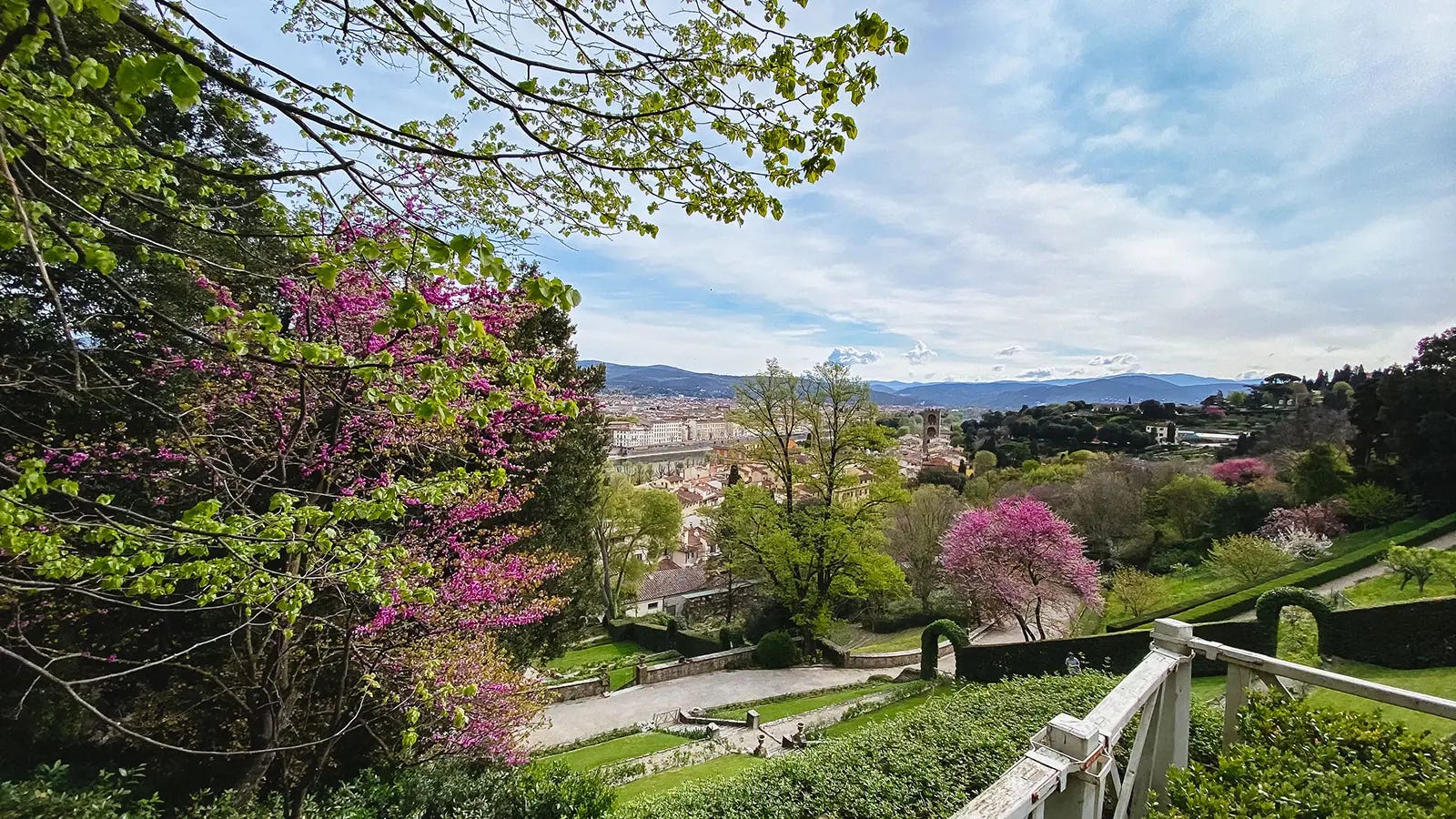
At the upper levels, Florence opens before you. The Duomo’s dome, church towers, rooftops, and the Arno create a panorama that feels entirely different from the perspective at street level. The staircase is not simply a route to the top, shaping the expression of getting there. Be it a grand flight, spiral, or helical, every set of steps caries us into a story. Each landing offers another frame of Firenze.
“The finest places do more than captivate the eye, they reveal the brilliance, imagination, and human spirit behind every detail.” - KR