

This is a tale of our recent autumn sojourn in Florence, which materialized from an incisive inquiry. As we plotted our expedition, my husband inquired the true nature of my desires for the venerable Tuscan capital. I avowed a singular ambition, to circumvent the tourist thoroughfares and seek out the true custodians of the region’s culinary soul.
Deep down, I yearned to re-examine my culinary lineage across Hong Kong to California, and, ultimately, to Italy. A steadfast discipline that echoed my own four-year apprenticeship in Italian cuisine, during my formative tenure under Chef Vincenzo, the Sicilian-born master of Dal Baffo, in Menlo Park.
The realization of that yearning, however, unfolded with an unanticipated serendipity that only Florence can crystallize during the first week of October.
Serendipitous Discovery


Following an afternoon absorbing the echoing, cavernous halls of the city’s galleries, we drifted into the medieval labyrinth, that is Florence, and found ourselves drawn into an artisan leather boutique, a lucid, austere sanctuary showcasing the handcrafted leatherwork that contemporary design honors un-compromised execution. Sensing my immersion in the room’s immaculate discipline, my husband stepped outside, granting me the luxury of solitary contemplation.
When I rejoined him on the cobbled streets, he offered an enigmatic smile, “Let’s go in there,” he suggested, pointing to an understated façade a mere pace away. “I have something to show you.”
Lo and behold, his intuition had led us to the exact sanctuary I sought: the legendary Biscottificio Antonio Mattei Museo Bottega.
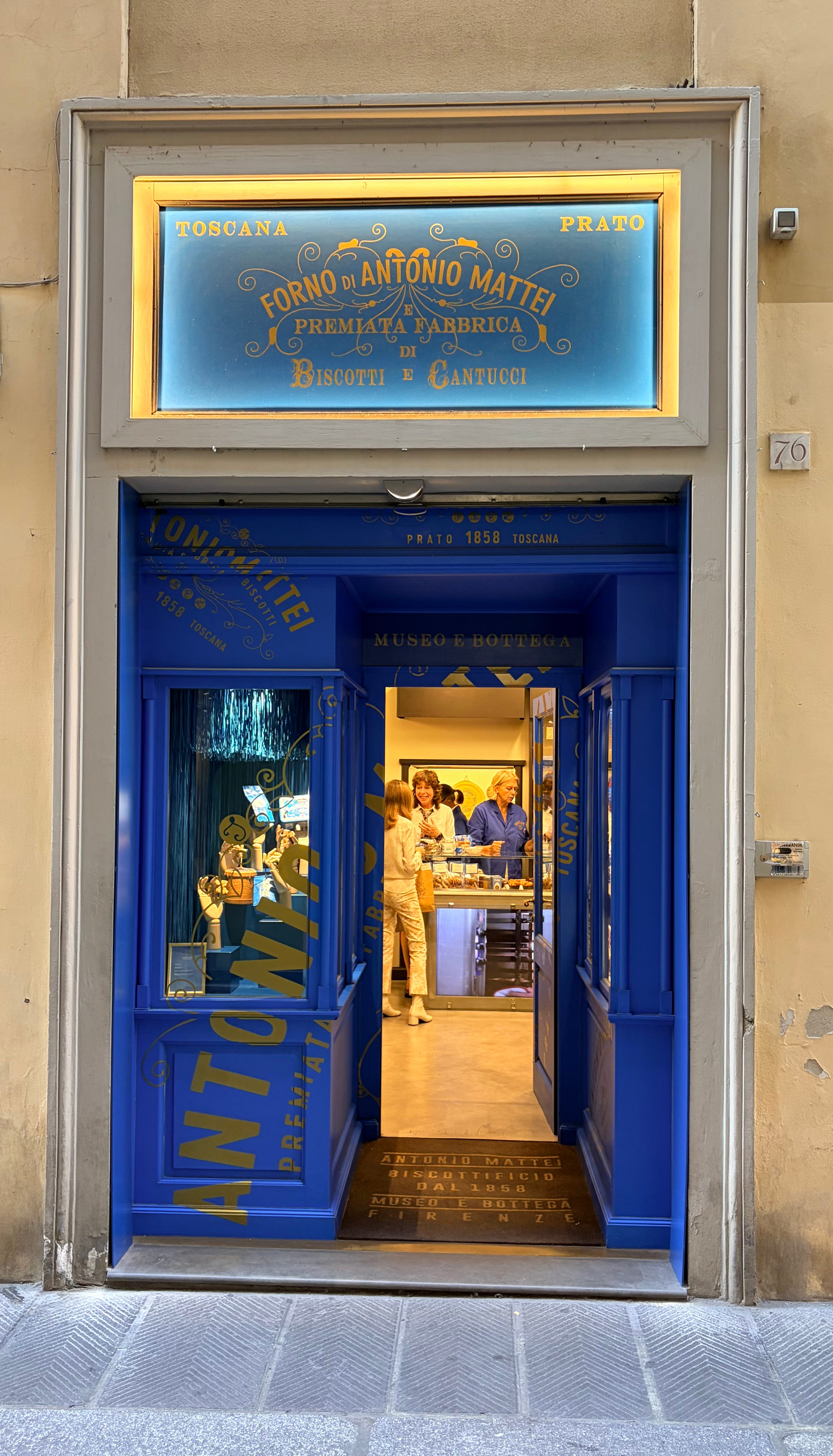
Across the threshold, the atmosphere shifted. Carlotta Mocali, long-standing family member and manager presiding over the museum shop and laboratory, greeted us with unfeigned graciousness. Speaking in a fluent, melodic cadence, she enveloped us in authentic hospitality.
Recognizing a fellow votary of culinary virtuosity, she invited us upward into the private museum. A space to tell the story of the Mattei archive and to view the formal opening of their upstairs exhibition, noting that the Mayor of Florence, would soon be in attendance to mark the civic celebration, bestowing a commemorative scroll.
The upper salon, hummed with a fervid pulse, flashing optics and animated discourse rebounding off centuries-old masonry. Amidst the dynamic reception, I conversed with the executive chef who catered the event. I also met and engaged in a deeply kindred dialogue with Elisabetta, one of the four sibling owners.


Our meeting, shaped by a shared exploration of the oven’s geometry and the lineage of the dough, brought us to a deeper appreciation of the virtuosity behind the mastery. Moved by my background and shared reverence for their artistry, Elisabetta, proffered an explicit summons; to present myself at their historic production factory the following morning. Just like that, handwritten transit coordinates for Prato, where the Antonio Mattei laboratory was located, materialized in my plan.
“True Hospitality is a sudden window of joy, a generous sharing of time and light that turns an unplanned path into a lovely, lasting friendship.” - Kiran Robinson
Traversal to Prato
Mindful of a 9:00 A.M. appointment and unwilling to gamble on regional rail, we opted for a private car orchestrated seamlessly by our curator at This Time Tomorrow.
Our driver proved to be an erudite local chronicler who mapped out Prato’s industrial history en route, whereas the return journey was an unhurried, non-negotiable train passage back into Florence.
As we neared the destination, the warm-scented core of the fragrance of biscuit loaves fresh out of the oven, lured us to the historic quarters on Via Ricasoli. Both Carlotta and Elisabetta greeted us at the portal with radiant smiles, receiving us as long-estranged colleagues.


They guided us through an intimate traverse of the operational floor, heavy with the invigorating perfume of toasted almonds and pine nuts. The entire brigade radiated an infectious, high-octane devotion. They paused their synchronized labor for shared photographic keepsakes.
Entering the bakehouse floor, any trace of pedestrian monotony vanished, replaced by an incandescent, lyrical electricity. Every visage bore an unforced grin, signaling a visceral love for the work. The artisans moved with choreographed exactitude, executing an infallible synthesis of thermal force and time. Long golden loaves emerged gleaming from the hearths, sliced with surgical swiftness while venting vapor.
The nascent Cantucci arrayed on cooling racks, their perimeters setting into an adamantine snap. The cooled biscuits migrated to the packaging stations, where deft fingers arrayed them in crisp files, swathed in trademarked paper and secured with a final, deliberate knot of string.
The sensory zenith of the floor manifested at the hearth ovens. Right as a fresh batch of toasted brioche slices emerged piping hot, the team intercepted them for us. Most certainly redefining the breakfast paradigm.
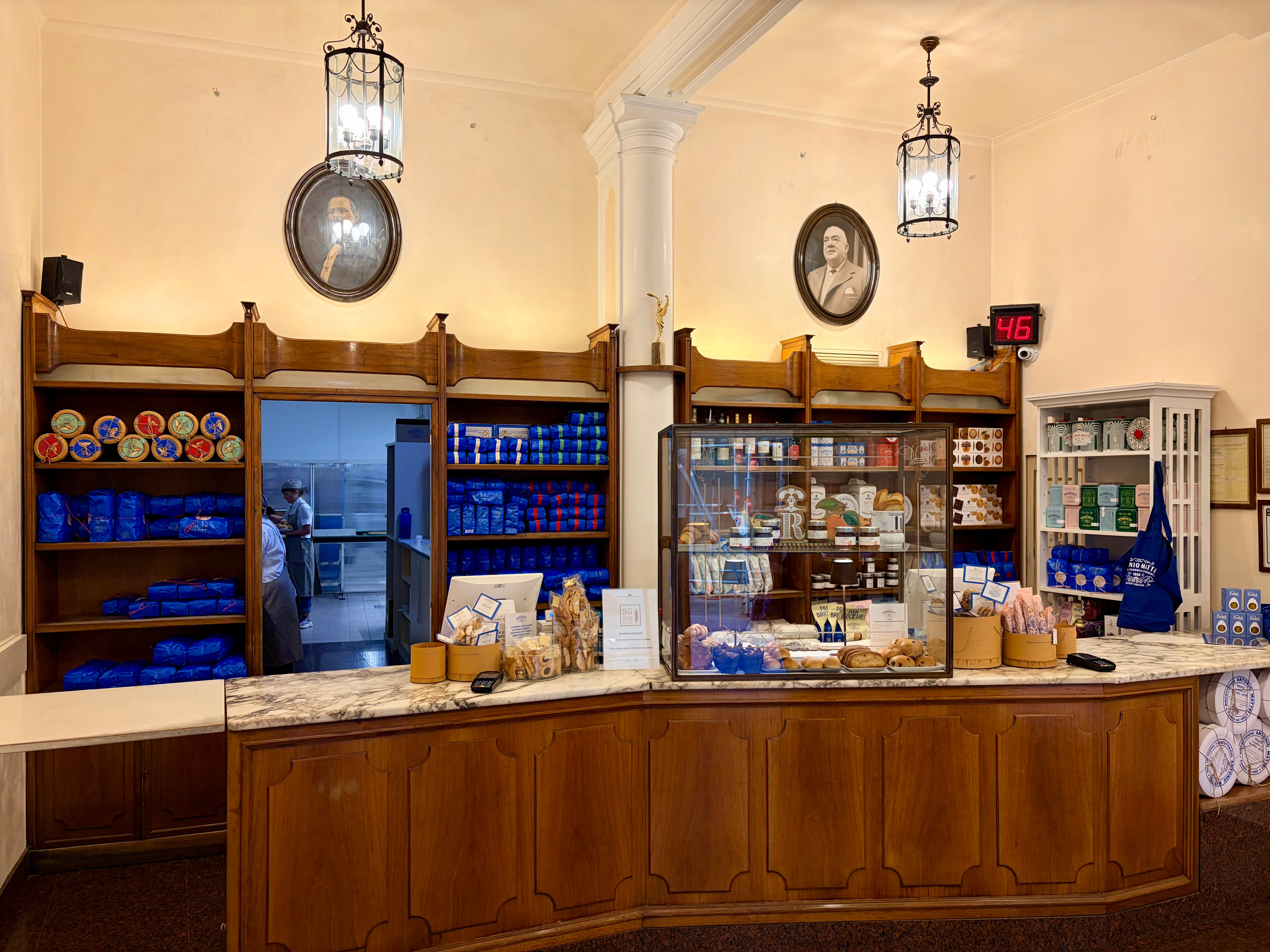
Just steps away from the thermal heart of the laboratory, the historical storefront-anchored by weathered marble and vintage cabinetry crystallizes the spirit of the place. The shelves displayed bespoke ceramic ware, embossed tin caddies, hat boxes, and other artisan kitchen accoutrements.
Archive of Culinary Heritage
The lineage spans nearly two centuries
1858: Founded by the visionary baker Antonio Mattei
1904: Transitioned to Tommaso Pandolfini and Egisto Ciampolini
1920: Ernesto Pandolfini assumed command, executing the strategic pivot to abandon general bread production and consecrate the ovens exclusively to elite confections.
Present Day: Preserved by Ernesto’s fourth-generation grandchildren.
The renown of Biscotti di Prato, faithful to the 1858 matrix; choice soft wheat flour, free-range eggs, whole unpeeled almonds, and pine nuts, without commercial shortcuts or chemical leavening. The mastery is temporal and thermal. Shaping dense logs, executing the diagonal incision while the crumb breathes steam, and committing the pieces to a secondary dehydration pass yields an adamantine crunch designed explicitly for liquid immersion.


Expanded Catalog
Whilst the 1858 almond recipe remains the sacred blueprint, successive generations have curated an adjoining repertoire of artisanal confections.
Brutti Buoni (“Ugly but Good”)
Conceived around 1910 by Aunt Italia Ciampolini. A zero- waste triumph utilizing residual egg whites and sorted almond fragments.
Torta Mantovana (“Mantuan Cake”)
An orange-infused, high-yolk, butter-rich sponge blanketed in a coarse crust of almond kernels.
Modern Biscotti Evolutions
Faithful to the structural snap, substituting nuts with hefty inclusions of dark chocolate (crimson wrap) or pistachios (emerald wrap).
Toasted Brioche Slices
Twice-baked, double-leavened rounds in classic, whole meal, and sugar-free matrices.
Ritual of Consumption
The locals have their own traditions, the ritual dictates pairing them with Vin Santo; sweet fortified Tuscan “Holy Wine.” At the conclusion of a meal, amber wine is poured, and the biscotto is submerged for a calculated count.
The dense crumb acts as a capillary sponge, absorbing honey, and stone-fruit esters, softening the bite into a delicate, complex luxury. At dawn, the identical immersion is honored with a sharp espresso.
Closing the Circle
As our extraordinary visit drew to a close, the team extended one final, generous gesture. We were presented with a signature blue package of fresh Brutti Buoni to take back with us. Carrying that parcel out into the afternoon sun felt like holding a physical artifact of living history.
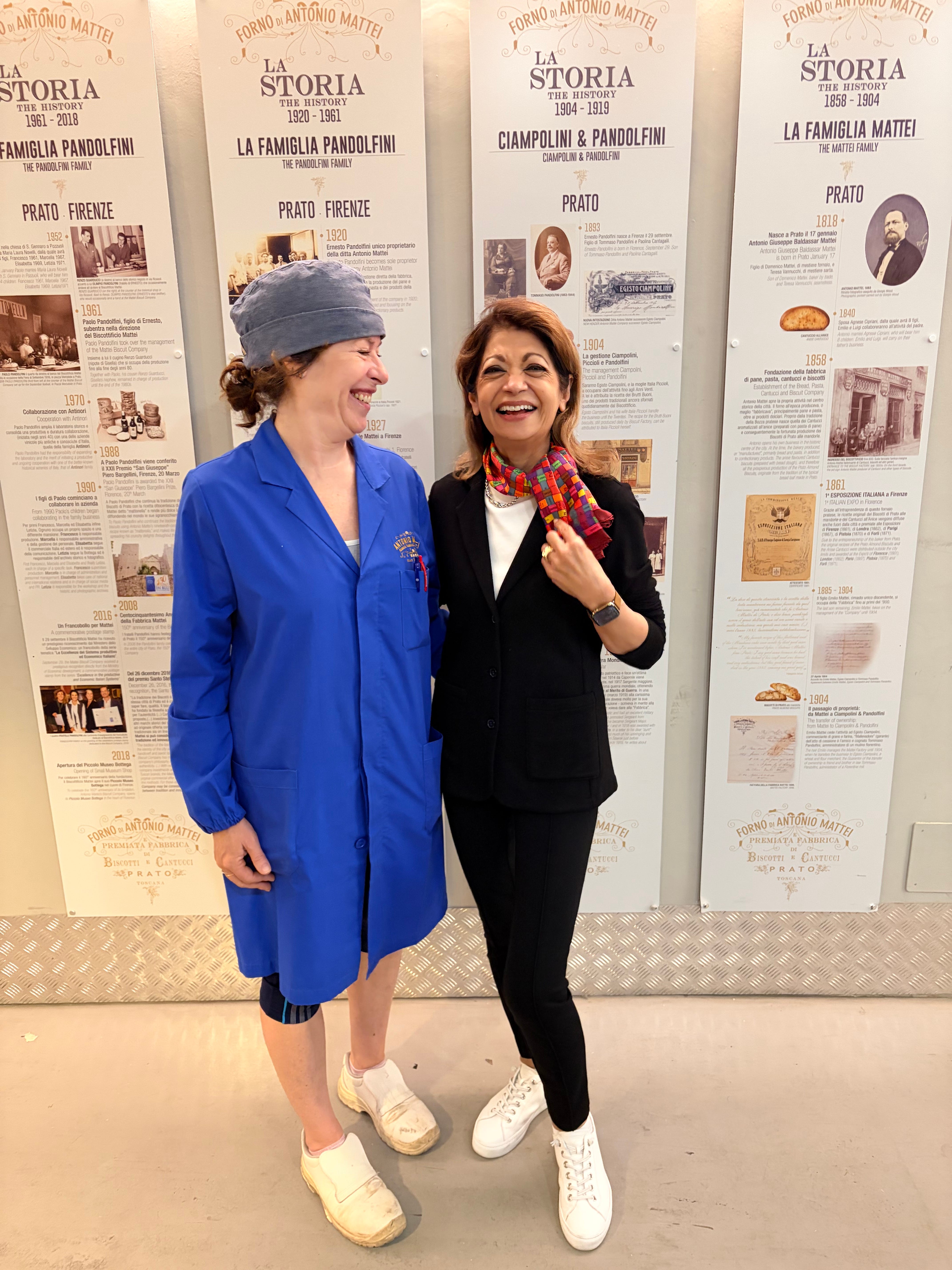
Our return rail journey to Florence was enlivened by animated discourse, celebrating the sheer generosity of time, talent, and grace extended to us. What began as a casual query had evolved into a convergence of my personal past and a grand culinary present. It closed a flawless circle stretching from Hong Kong to my formative years at Dal Baffo, and finally, to the very Tuscan roots where this family safeguards their delicious art.
“Every Biscotto (singular) tells a story, each one honors a heritage.” - Kiran Robinson
Grazie alla famiglia! Alla prossima (Until next time)
Florence, to be continued……