

This week we continue Rediscovering Cooking and identifying your own personal style in the kitchen through practice.
Think of cooking like a musical composition. Recipes are like a piece of music, and the cook is the conductor of an orchestra of ingredients.
There come moments when following a recipe is no longer about instructions (i.e., reading the notes on a musical score), but about how your style or form takes shape in practice.
This is true whether the recipe was created by Gordon Ramsay or your grandmother!

What sits in a composition is not always immediately understood. Ingredients can be clear, yet their role in the recipe does not always register at first glance. Recognition and comprehension are not the same thing.
It’s when they come together through practice and interpretation that true “music” is made.
Reading the Same Composition Differently
While reviewing preparation notes with my team ahead of lunch service, I sensed something wasn’t quite right. On paper, the composition was straightforward. Yet as my team moved through it together, it became clear that each person was interpreting the recipe slightly differently.

One focused on speed, preparing every element in advance, assuming the dish was about assembly rather than timing.
Another prioritized presentation, thinking first about plating order without fully considering temperature and sequence.
A third followed the method exactly as written, but without adjusting for volume, which would have affected consistency during service.
We all tend to gravitate towards the thing(s) we know well.
Here’s the point: nothing was incorrect in isolation, they just weren’t aligned. So we stopped. Not to correct the dish, but to align on how it was being interpreted.
From Following to Interpreting
That difference is not small. It alters what is seen and what is missed.

Following a recipe begins well before we read it. It begins in the state of mind we bring to it, whether alert, distracted, open or fixed. It continues in how uncertainty is handled: What requires immediate interpretation? What needs to be revisited? What does not work well?
Some compositions are not built for immediacy. They only reveal themselves when given distance and repetition.
There is discipline in not rushing toward closure when we cook. In allowing instructions to remain partially formed rather than forcing early conclusions. In resisting the urge to move on or to simplify too quickly.
Interpreting a recipe becomes recognition of method. This happens over time and has little to do about what is written on the page.


This is why I had included my procurement team and vendors in these planning sessions, to learn, and to better align before preparing a new dish. This way, we could gain consistency, knowledge, and a shared vision for the composition.
The team was present not only in execution, but in interpretation. Over time, this exposure shaped how they approached preparation itself.
Shaping the Composition
Finding (or rediscovering) your form in the kitchen requires practice. Just like an orchestra will rehearse again and again. It’s no different whether you are a home cook or professional chef.
Rehearsal is not simply getting the recipe “just right”. Practice generates a style of cooking. One that hones your mindset, techniques, and ultimately your own interpretation of the recipe.


Take bread as an example. For some, baking can seem intimidating. However, bread baking builds consistency.
It depends on time, repetition, and care in maintaining the starter. Each step carries weight, and nothing can be rushed without affecting the result.
Want to find your “form” in the kitchen? Try this bread recipe and let the sweet aromas linger like a well-orchestrated piece of music.
Recipe: Artisan Sourdough Bread (a.k.a., Hearth Bread)
Served with Farmers Market Harvest, a distinctive contrast of earthy greens Artichokes, Fava Beans, Asparagus, English Peas, Radishes, Sorrel, Peppery Spring Mix.
Jewel-toned fruit such as Apricots, Blood Oranges, Grapefruit, Cherries, Peppery Spring Mix, Rhubarb and the first sweet surge of Berri and Cherries.
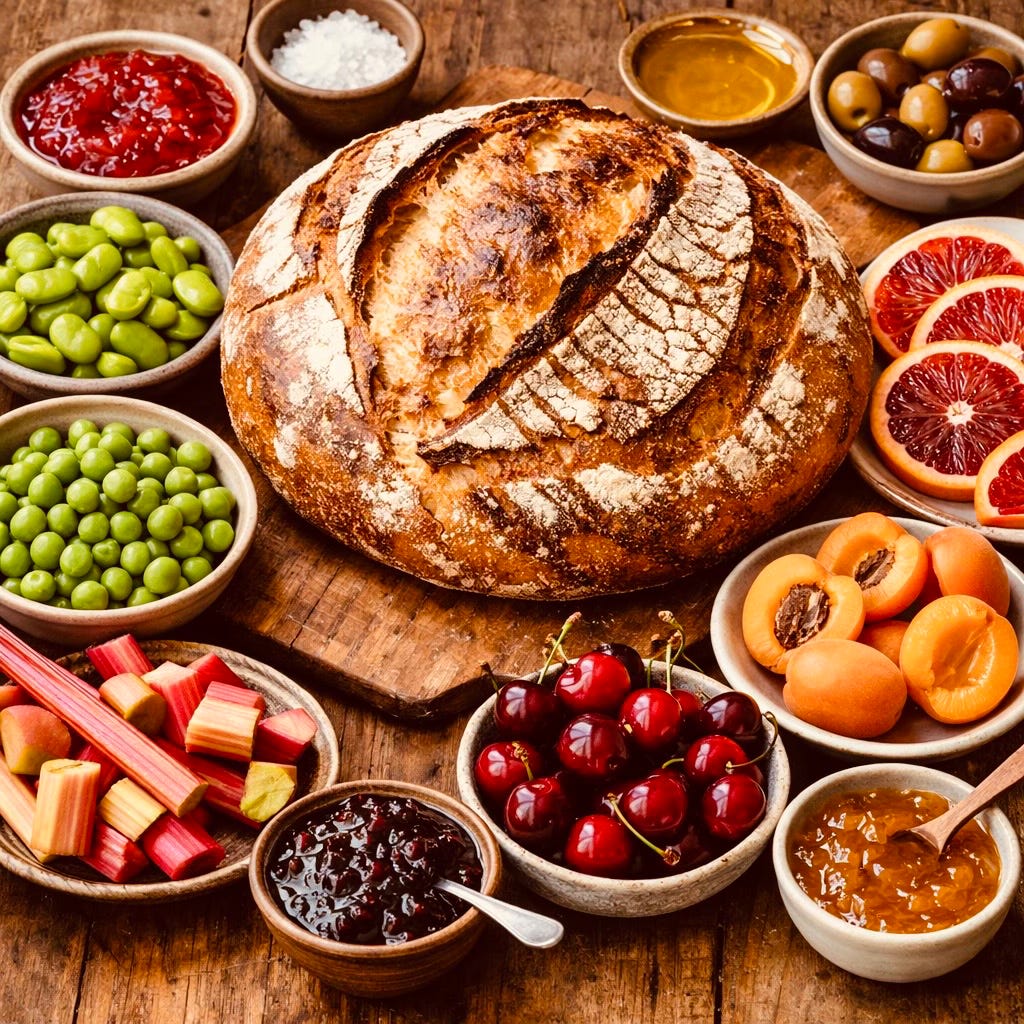
In France: Pain au Levian. In Italy: Pane di Altamura. In Germany/Austria: Sauerteigbrot. In Denmark: Rugbrød. In Spain: Masa Madre.
Powered by fermentation, perfected by time, the artisan craft, boule reveals bread in its most honest geometry.
Ingredients: 100g active sourdough starter, 1.5 cups warm water, 4 cups all-purpose flour, 1 tbs. fine sea salt
Tools: Large Bowl, Spatula, Damp Cloth, Floured Basket, Sharp Knife, Dutch Oven with Lid,
Method: In a large bowl use the spatula to mix in water and starter. Mix by hand until a rough dough forms.
Cover with the damp cloth and allow to rest for 20 minutes.
Over the next 2 hours gently stretch the dough and fold it over itself. Do this 4 times per session, resting in between.
Repeat this process 4 times total during the 2-hour period.
Bulk Fermentation: Cover the bow with damp cloth. Leave at room temperature for 6-10 hours, until the dough rises by about 50% and looks bubbly and airy.
Turn the dough into a clean surface. Gently fold the edges into the center to build tension.
Flip it over and shape it into a smooth round ball.
Cold Proof: Place the dough into a floured banneton basket lined with a floured towel. Cover and refrigerate for 12-15 hours. This slow fermentation develops flavour and tang.
Bake: Preheat oven to 250C (480F), place a Dutch Oven inside (a heavy, thick-walled pot with a tight-fitting lid, usually made from cast iron.) It helps trap steam released from the dough, rise higher, and yields a crisp golden crust.
I love this analogy. Just like a great hotel experience, the best meals come from that intuitive "interpretation" and flow rather than just sticking strictly to the script. Such a thoughtful way to look at the craft!
Thank you for the observation!!